
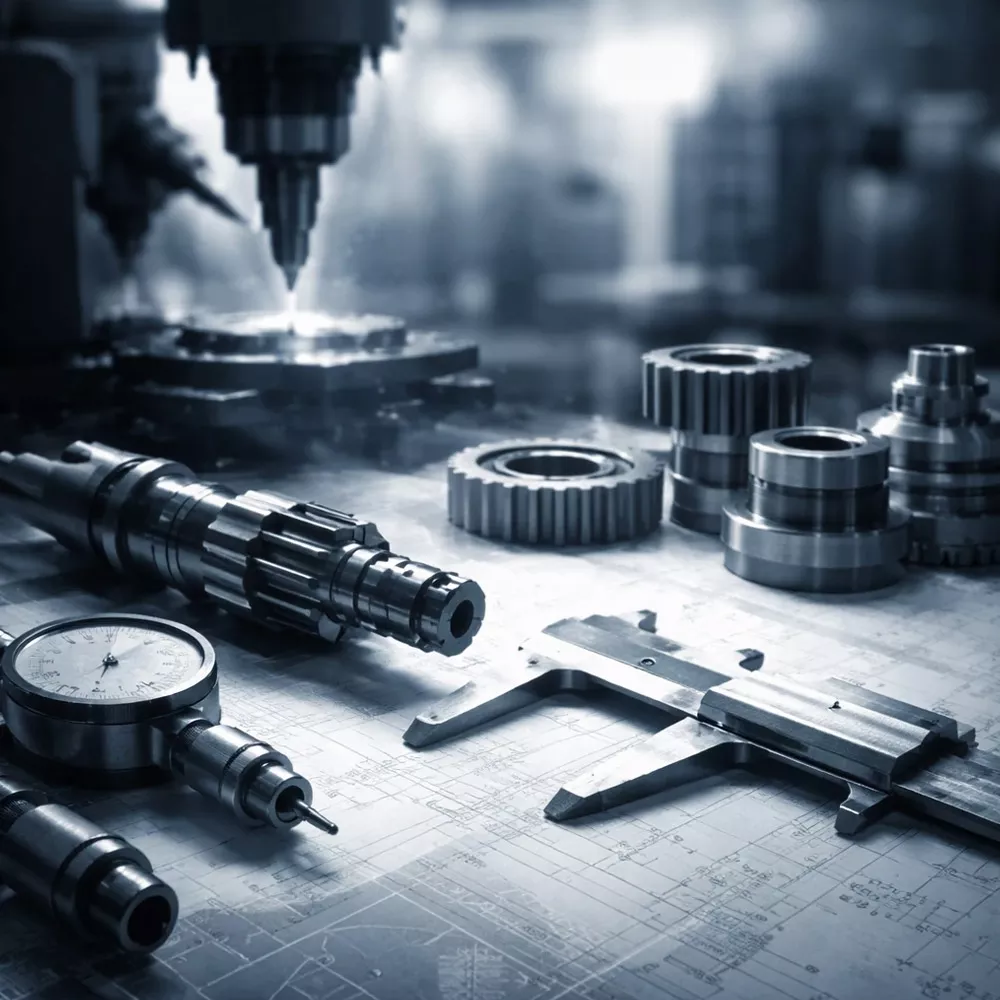
Hidden Engineering Factors Beyond Catalogs, Certifications, and Brand Names
Introduction: The Manufacturer Is Part of the Design
In engineering practice, manufacturer evaluation is often reduced to catalogs, certifications, and brand familiarity. Torque ratings, ISO standards, and glossy datasheets dominate selection discussions.
Yet in real systems—especially in power transmission, marine, and heavy industrial applications—the manufacturer itself becomes an implicit design variable.
What many engineers miss is that manufacturing capability, process discipline, and organizational engineering culture directly influence load paths, reliability, tolerance behavior, and failure modes—often more than nominal specifications suggest.
1. Catalog Data ≠ Manufacturing Reality
Most catalogs assume:
- Ideal alignment
- Uniform material properties
- Controlled assembly conditions
- Perfect lubrication regimes
In reality, manufacturers differ significantly in how closely production matches these assumptions.
What’s often missed:
- Variability in heat treatment batches
- Machining consistency across production runs
- Assembly torque control discipline
- Gear contact pattern verification practices
Two manufacturers may publish identical torque ratings, yet deliver fundamentally different operational reliability.
2. Manufacturing Tolerances Are System‑Level Parameters
Engineers frequently evaluate tolerances at the component level but overlook their system‑level accumulation.
Key overlooked questions:
- How does this manufacturer manage tolerance stack‑up across assemblies?
- Are tolerances statistical or worst‑case driven?
- Is backlash controlled by design intent or post‑assembly adjustment?
Tolerance philosophy directly affects:
- Noise and vibration behavior
- Load sharing in multi‑stage gear systems
- Bearing life under misalignment
This is not a drawing issue—it is a manufacturing signature.
3. Process Discipline Shapes Reliability More Than Materials
Material grade is easy to specify.
Process discipline is not.
What differentiates manufacturers is often:
- In‑process inspection frequency
- Traceability of critical components
- Handling of non‑conformities
- Feedback loops between failure data and design updates
A manufacturer with moderate materials but strong process control routinely outperforms one with superior materials and weak discipline.
4. Assembly Is a Design Phase (Whether Documented or Not)
Many failures attributed to “design flaws” originate during assembly.
Engineers often forget to ask:
- Who performs final alignment?
- Are preload settings measured or assumed?
- Are elastomers, couplings, or interfaces installed under controlled conditions?
- Is assembly repeatable across facilities?
From a system perspective, assembly quality defines initial conditions for the entire service life.
5. Testing Philosophy Reveals True Engineering Maturity
Certifications confirm compliance—not understanding.
More revealing questions:
- Is testing functional or failure‑oriented?
- Are overload, shock, or off‑design scenarios tested?
- Does testing validate assumptions or merely confirm nominal performance?
Manufacturers who test for failure learn faster—and design more robust systems.
6. Supply Chain Stability Is an Engineering Constraint
Lead times and sourcing are often treated as commercial issues.
In reality, they directly impact engineering outcomes.
Hidden technical consequences:
- Material substitutions during shortages
- Unannounced process changes
- Loss of dimensional consistency across batches
Engineers evaluating manufacturers must consider supply chain resilience as part of system reliability.
7. Brand ≠ Manufacturer ≠ Engineering Capability
A brand name often aggregates:
- Multiple factories
- Outsourced components
- Varying quality systems
What matters is not the logo, but:
- Where it is made
- How it is made
- Under what controls
In this sense, a brand functions as a probabilistic reliability indicator, not a guarantee.
8. Why This Matters in Power Transmission Systems
In gearboxes, couplings, and rotating machinery:
- Small deviations propagate through load paths
- Minor assembly errors amplify vibration
- Manufacturing variability alters fatigue behavior
Thus, the manufacturer is not external to the system—it is embedded in its mechanical behavior.
Conclusion: Evaluate Manufacturers as Engineering Systems
Engineers should evaluate manufacturers the same way they evaluate mechanical systems:
- Inputs (materials, processes)
- Transformations (manufacturing, assembly)
- Outputs (performance, reliability, degradation behavior)
Only then does manufacturer selection become a true engineering decision, not a procurement shortcut.
