
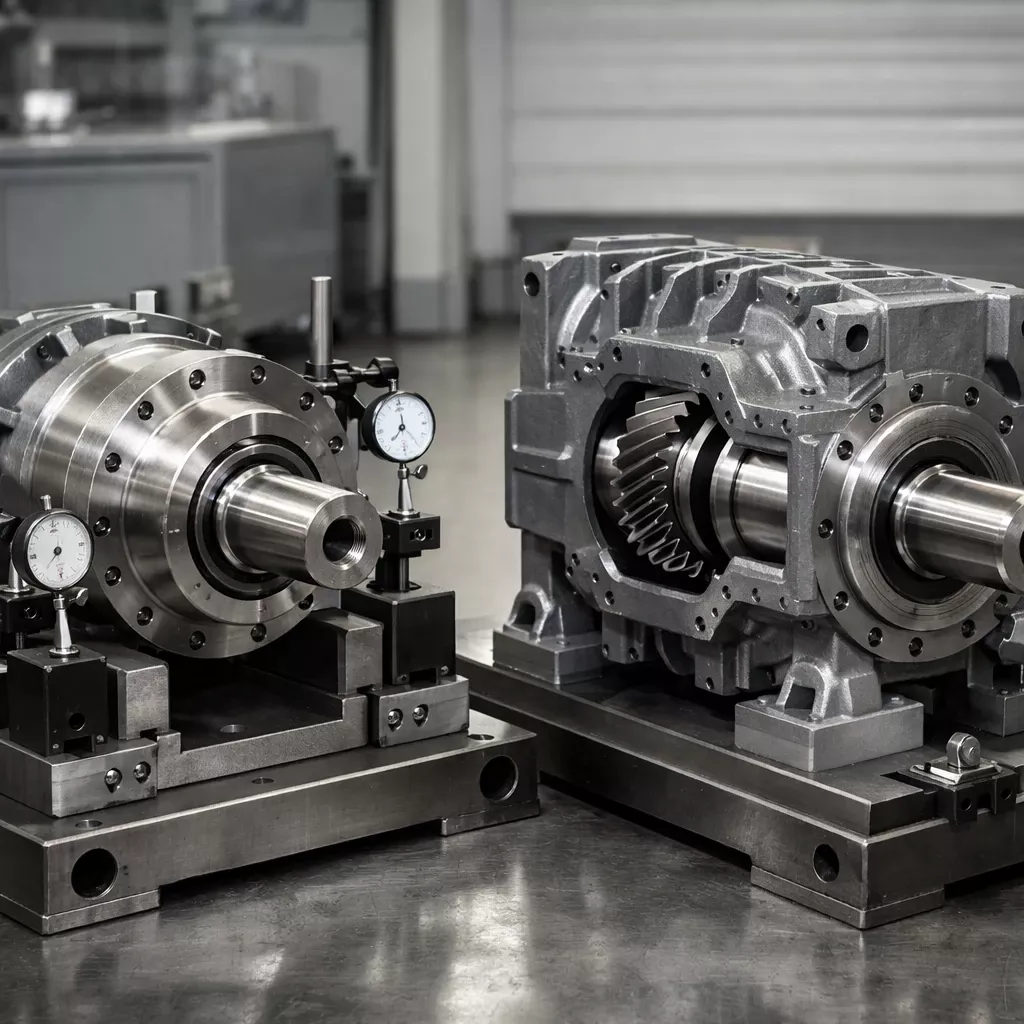
Introduction – Why Gearbox Architecture Defines System Performance
In modern industrial systems, performance limitations rarely originate from control logic or motor capability alone. Far more often, long‑term efficiency, positional accuracy, energy consumption, and mechanical reliability are defined by the gearbox architecture chosen at the heart of the drivetrain.
As industrial automation evolves toward higher torque density, tighter installation envelopes, and lower lifetime operating cost, gearbox selection is no longer a catalog exercise. It is a strategic engineering decision that directly affects machine uptime, thermal behavior, maintenance cycles, and total cost of ownership.
Among available reduction technologies, planetary gearboxes and helical gearboxes dominate high‑performance industrial applications. Each embodies a fundamentally different mechanical philosophy. This guide provides an engineering‑grade comparison of both technologies, focusing on architecture, performance trade‑offs, and correct selection methodology.
Fundamentals of Industrial Power Transmission
An industrial gearbox modifies rotational speed and torque between a prime mover (electric motor or servo motor) and a driven load. Motors typically operate at high speed and relatively low torque, while industrial processes require reduced speed and amplified torque.
The gearbox performs this transformation mechanically while influencing efficiency, noise, precision, and durability.
Torque, Ratio, and Efficiency
Output torque is defined as:
Output Torque = Input Torque × Gear Ratio × Efficiency
Where:
- Gear Ratio defines speed reduction
- Efficiency determines how much input power reaches the output shaft
Even small efficiency differences become critical when gearboxes operate continuously for thousands of hours annually.
Backlash and Torsional Stiffness
Backlash is the angular clearance between mating gear teeth during reversal of load direction.
It directly affects positional accuracy, vibration, and control stability.
- Low backlash (< 5 arc‑minutes) is critical in servo‑driven and indexing systems
- Higher backlash is acceptable in continuous‑rotation applications such as conveyors
Service Factor and Load Severity
Service Factor (SF) accounts for:
- Shock loading
- Duty cycle
- Environmental conditions
Rated gearbox torque must always exceed peak operating torque multiplied by the appropriate Service Factor to ensure fatigue‑free operation.
Planetary Gearboxes: Architecture and Performance Characteristics
Operating Principle
A planetary (epicyclic) gearbox consists of:
- Sun gear (central element)
- Multiple planet gears
- Planet carrier
- Internal ring gear
The defining feature is load sharing. Output torque is divided across multiple planet gears instead of being carried by a single gear mesh.
This fundamental principle enables characteristics unmatched by parallel‑shaft designs.
Key Advantages
Exceptional Torque Density
Load sharing allows planetary gearboxes to transmit very high torque within compact envelopes.
Coaxial Geometry
Input and output shafts are aligned, simplifying mechanical integration and reducing misalignment risk.
Low Backlash and High Stiffness
Precision manufacturing and bearing preloading techniques enable extremely low backlash, making planetary systems ideal for servo and positioning tasks.
High Efficiency per Stage
Modern planetary gear stages routinely exceed 95–97% efficiency under proper lubrication.
Engineering Considerations
- Thermal management is critical due to high power density
- Manufacturing quality directly determines load sharing accuracy
- Planetary systems demand tighter tolerances and advanced heat treatment processes
Helical Gearboxes: Proven Reliability and Smooth Power Transmission
Operating Principle
Helical gears feature teeth cut at an angle relative to the shaft axis.
This creates progressive tooth engagement rather than instantaneous contact.
Key Advantages
Smooth and Quiet Operation
Gradual load transfer dramatically reduces noise and vibration.
High Continuous Load Capacity
Larger gear faces and higher contact ratios enable reliable operation under steady loads.
Thermal Stability
Larger housings dissipate heat more effectively, supporting continuous operation.
Mechanical Simplicity
Fewer components and straightforward layouts simplify inspection and service.
Engineering Considerations
- Axial thrust generated by helical teeth must be managed via bearing selection
- Backlash is inherently higher than in precision planetary designs
- Larger physical size is required for equivalent torque capacity
Head‑to‑Head Engineering Comparison
Torque Density and Footprint
Planetary gearboxes provide significantly higher torque in a smaller volume due to multi‑gear load sharing.
Precision and Backlash
Planetary systems dominate in precision applications. Helical gearboxes are better suited where smooth rotation matters more than positional accuracy.
Efficiency
Both designs are highly efficient. Single‑stage helical gearboxes can match or exceed planetary efficiency, while multi‑stage planetary systems maintain efficiency at higher ratios.
Noise and Vibration
Helical gearboxes offer superior acoustic performance due to progressive tooth engagement.
Cost and Maintainability
Helical designs tend to be more cost‑effective initially and easier to service. Planetary gearboxes often deliver superior lifetime value in high‑duty applications.
Application‑Driven Selection Guidance
High Precision & Dynamic Systems
Robotics, CNC machines, indexing tables
→ Planetary gearbox
Compact High‑Torque Systems
Steel processing, heavy presses, wind turbine stages
→ Planetary gearbox
Continuous Duty, General Industry
Conveyors, mixers, agitators, material handling
→ Helical gearbox
Noise‑Sensitive Environments
Food processing, packaging machinery
→ Helical gearbox
Mixed Precision Systems
Packaging lines, printing machinery
→ Combination of planetary (precision zones) and helical (power transmission)
Engineering Selection Framework
- Define required output torque and speed
- Identify peak load conditions and Service Factor
- Establish backlash tolerance
- Evaluate space and mounting constraints
- Compare total cost of ownership, not just purchase price
Correct gearbox selection minimizes downtime, reduces energy consumption, and extends system life.
Industry Insight: Planetary Engineering at Scale
In high‑demand industrial environments, planetary gearbox performance depends heavily on manufacturing discipline—gear metallurgy, heat treatment depth, carrier rigidity, and bearing architecture.
Field experience across heavy automation sectors consistently shows that well‑engineered planetary systems outperform conventional reducers when space, stiffness, and precision requirements converge.
Conclusion
Planetary and helical gearboxes are not competitors—they are solutions to different engineering problems.
Helical gearboxes remain the backbone of industrial motion thanks to simplicity, smooth operation, and robustness.
Planetary gearboxes enable compact, high‑precision, high‑torque systems where traditional architectures reach their limits.
Understanding these distinctions allows engineers to design machines that are not merely functional—but optimized, efficient, and reliable under real operating conditions.
