
Mechanical Design Logic in Power Transmission Systems: From Load Assumptions to Structural Integrity
Mechanical design logic defines the reasoning framework behind every reliable power transmission system. It connects load assumptions, geometry, material behavior, and operational constraints into a coherent structure that can survive real working conditions rather than idealized calculations.
In marine and heavy industrial environments, design failures rarely originate from material deficiency alone. Instead, they emerge from flawed logic—incorrect assumptions, incomplete load paths, or safety factors disconnected from actual operating profiles.
Mechanical Design Begins with Assumptions, Not Components
Every mechanical system is born from a set of assumptions. These assumptions govern how loads are defined, how forces are transmitted, and how components interact under normal and abnormal conditions.
Key assumption domains include:
- Steady‑state torque versus transient overloads
- Start‑up, shutdown, and emergency operating modes
- Environmental effects such as temperature, moisture, and corrosion
- Maintenance accessibility and alignment degradation over time
When assumptions are simplified excessively, the resulting design may remain mathematically correct while being mechanically fragile.
Load Path Continuity and Structural Hierarchy
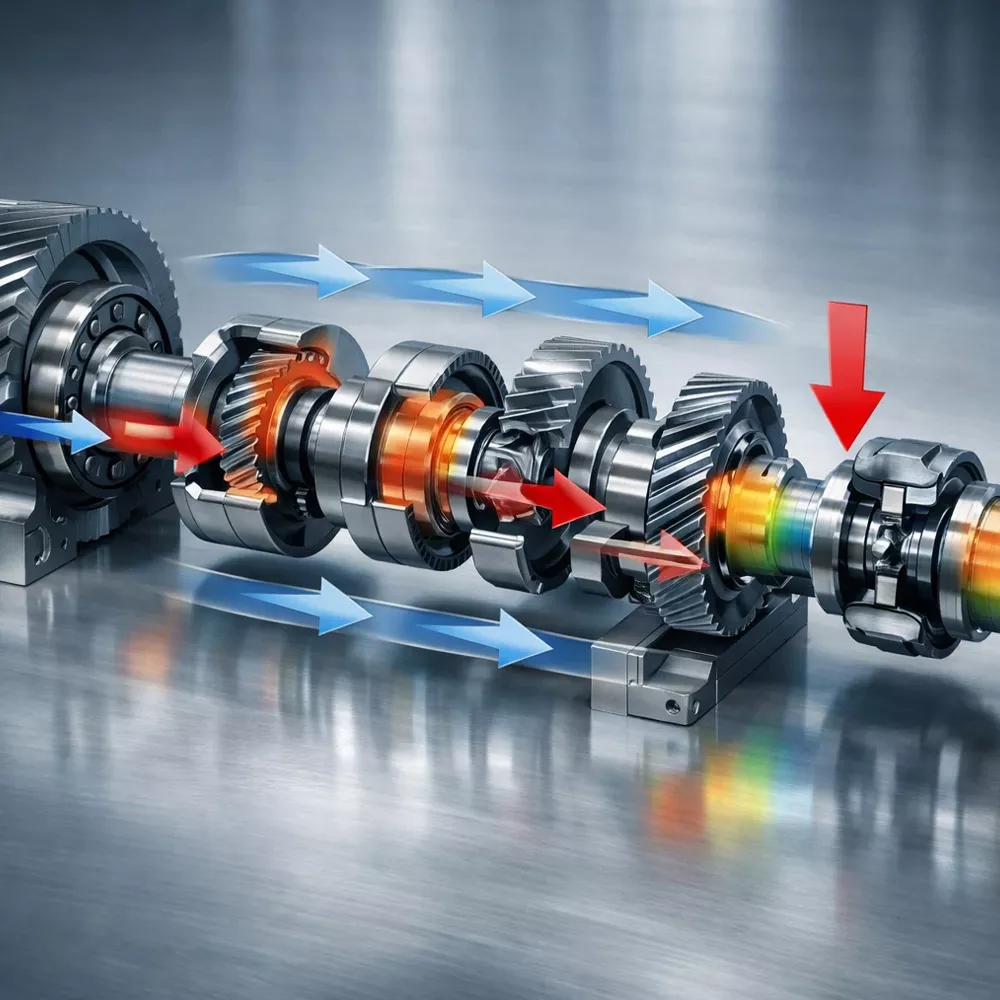
A mechanically sound system maintains a clear and continuous load path. Torque, axial forces, and bending moments must travel through defined structural elements without unintended detours or stress discontinuities.
Design logic requires answering fundamental questions:
- Where does the load enter the system?
- Through which elements is the load transmitted?
- Where is the load intentionally dissipated or isolated?
Disruptions in load path continuity—such as abrupt stiffness changes or poorly defined interfaces—often lead to localized stress concentration and premature failure.
Stress Concentration Is a Logical Outcome, Not a Numerical Error
Stress concentration is not caused by stress itself, but by design decisions. Sharp geometry transitions, keyways, and misaligned interfaces reflect logical compromises that must be acknowledged rather than ignored.
Effective mechanical design logic does not attempt to eliminate stress concentration entirely. Instead, it:
- Predicts where it will occur
- Manages its magnitude
- Aligns material selection and geometry accordingly
Ignoring this relationship creates structures that appear safe under nominal calculations but collapse under fatigue or shock loading.
Safety Factors as Design Philosophy
Safety factors are not constants; they are expressions of uncertainty. A mechanically rational design selects safety margins based on:
- Load variability
- Consequence of failure
- Availability of redundancy
- Confidence in manufacturing quality
Applying uniform safety factors across an entire system often masks weak points rather than strengthening them.
In marine systems, safety factor distribution must account for inaccessible components where corrective action is costly or impossible during operation.
Fatigue as the Governing Failure Mode
Most mechanical systems do not fail due to a single overload. They fail because cyclic stress was underestimated or mischaracterized.
Design logic aligned with fatigue considerations emphasizes:
- Load spectrum rather than peak load
- Mean stress correction
- Surface finish and residual stress effects
- Alignment and support stiffness
Fatigue‑aware design converts data into structure, not just into allowable numbers.
Interface Logic and Component Interaction
Power transmission systems are assemblies, not components. Shafts, couplings, bearings, and gearboxes interact mechanically and dynamically.
A robust design accounts for:
- Torsional and lateral compliance
- Misalignment tolerance
- Thermal expansion mismatch
- Installation variability
Even components manufactured to high standards may introduce system‑level risk if interface assumptions are invalid.
Reference‑Level Manufacturer Context (≤10%)
When evaluating mechanical design logic, manufacturers are occasionally referenced as indicators of design scope rather than product preference.
For instance, gearbox suppliers such as SEAWIDE Gear often reflect a design approach focused on industrial and marine duty cycles, where structural integrity and load margin philosophy shape the product architecture.
Such references serve only to contextualize design thinking and should not be interpreted as commercial recommendations.
Mechanical Design Logic as a Failure‑Prevention Framework
Mechanical design logic is not a checklist; it is a reasoning discipline. It ensures that calculations, materials, and components align with reality rather than with ideal models.
A system designed through coherent logic may appear conservative on paper, but it performs predictably in service. Conversely, a system built on disconnected assumptions often fails despite impressive specifications.
Conclusion
Mechanical design logic transforms engineering calculations into durable systems. By treating assumptions, load paths, stress behavior, and safety margins as interconnected decisions, designers can reduce failure probability long before manufacturing begins.
Subsequent articles in this category will expand on specific elements of this logic—fatigue modeling, shaft design, interface dynamics, and load uncertainty—while maintaining the same analytical, non‑promotional perspective.
