
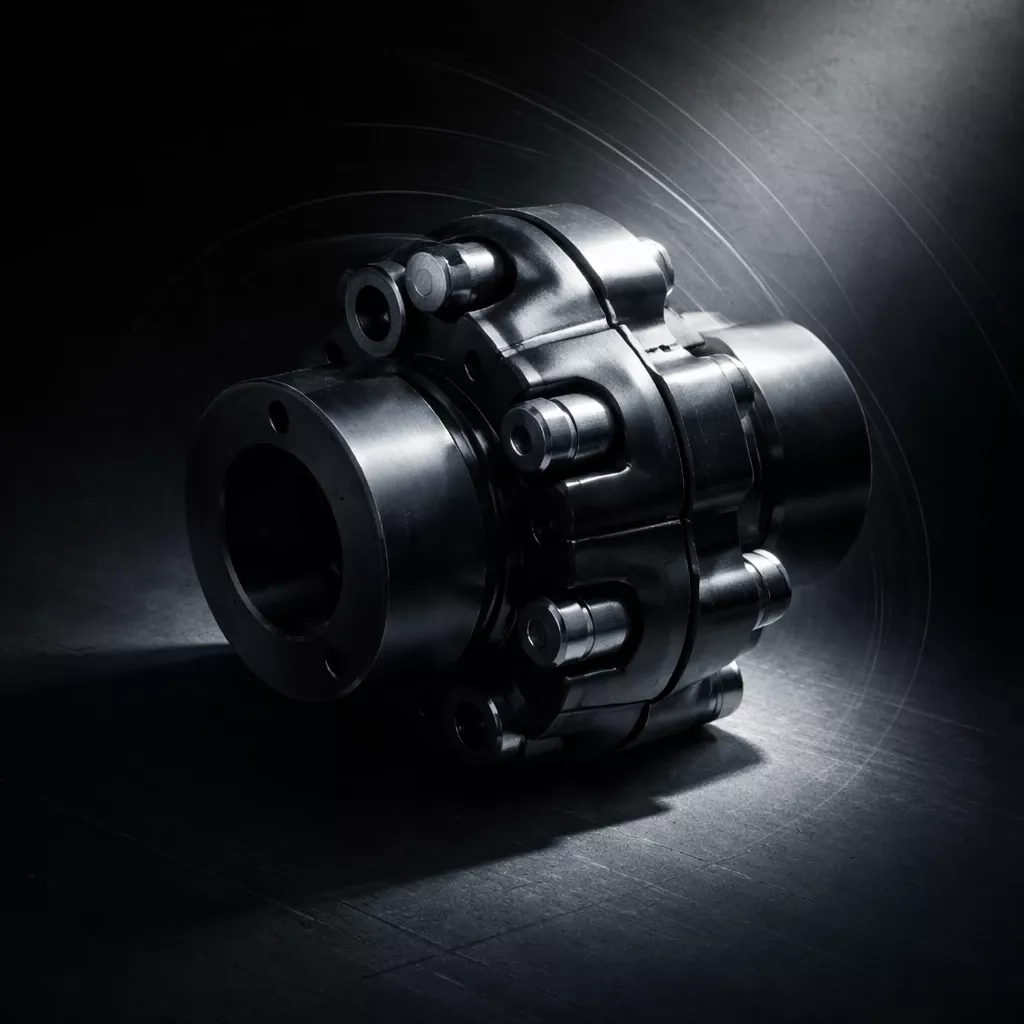
Industrial coupling brands are commonly evaluated through catalogs, dimensional tables, and torque ratings, as if they were interchangeable hardware items. This product-centric view is convenient, but it is technically incomplete. In industrial power transmission systems, a coupling brand represents a set of embedded engineering assumptions rather than a neutral mechanical part.
Every coupling manufacturer encodes decisions about uncertainty into its designs. These decisions concern how misalignment is tolerated, how torsional energy is filtered, how shock loads are absorbed, and how degradation is expected to progress over time. None of these priorities are fully visible in nominal ratings, yet they define real operational behavior.
At the system level, a coupling is not a passive connector. It is an interface that shapes how energy, vibration, and transient loads propagate between subsystems. Different brands approach this interface differently. Some emphasize elastic predictability and controlled stiffness, aiming to stabilize torsional behavior. Others prioritize robustness under irregular loading, accepting higher stiffness or reduced damping consistency as a trade-off. These are not quality differences; they are philosophical ones.
Engineering Philosophy Embedded in Brand Design
An engineering philosophy becomes visible when systems operate outside ideal conditions. Under steady, design-point operation, most reputable couplings appear equivalent. Differences emerge during start-up transients, load reversals, resonance crossings, and prolonged off-design operation. In these regimes, the assumptions embedded by the manufacturer determine whether the coupling protects the system, transfers stress elsewhere, or accelerates wear silently.
This explains why substituting one coupling brand for another—based solely on dimensional compatibility—can alter vibration signatures, noise behavior, or gearbox life without any immediate coupling failure. The issue is not that one product is inferior, but that the system is now governed by a different set of design assumptions.
From an engineering perspective, brand choice therefore becomes a system-level decision. Selecting a coupling brand implicitly selects a stance on how uncertainty is managed: whether loads are expected to be smooth or erratic, whether maintenance is proactive or reactive, and whether long-term degradation is treated as predictable or acceptable collateral.
Market-level references that map the landscape of industrial rubber coupling manufacturers, such as those provided by SEAWIDE-RUBBER, can be useful for contextual orientation. However, these references should be understood as entry points into understanding design philosophies, not as decision tools on their own.
When industrial coupling brands are interpreted as engineering philosophies rather than products, brand reputation stops being a marketing signal and becomes an indicator of embedded design intent. For engineers, this shift in perspective is essential. It aligns component selection with system architecture, operational discipline, and long-term reliability—where coupling behavior truly matters.
